| Headword | Balsamic Vinegar from Modena |
| Domain and subdomain | Food – other products |
| Grammatical label | Noun, sing. |
| Definition | Particular type of vinegar, produced in the areas of Modena and Reggio Emilia from fermentation of cooked grape must ripen for at least five years in barrels of different woods, from which it draws its aroma and colour, used as a condiment. (1) |
| Note | Balsamic Vinegar of Modena IGP (Indication of Geographic Protection) is obtained by adding the Concentrated Grape Must and/or Cotto of seven wine varieties (Lambrusco, Sangiovese, Trebbiano, Albana, Ancellotta, Fortana, Montuni) to the strong wine vinegar. Once these two components have been calibrated, in proportions that change according to the desired type, they are aged in wooden barrels for a period of not less than three years and beyond for mature vinegars. It is important to highlight that the noble part of Balsamic Vinegar of Modena IGP is the Cooked Must, as a consequence it is easy to understand that the higher is its quantity in a “Balsamic”, the higher its quality will be. Differently from the Traditional Balsamic Vinegar of Modena PDO (Protected Designation of Origin), the Balsamic Vinegar of Modena PGI will not undergo any change from barrel to barrel as in the traditional method, but will rest in the same barrel for as long as needed. (2) Modena IGP Balsamic Vinegar stands out for its limpid and brilliant appearance and for its delicate, persistent, pleasant and harmonious acidity. The colour is intense brown, and the smell is slightly acetic with woody notes. The taste is sweet, sour and balanced. (3) The production area of Balsamic Vinegar of Modena falls, according to tradition and in compliance with the regulations in force, in the provinces of Modena and Reggio Emilia. There, the presence of grapes characterized by the right concentration of sugar and acidity, is significant. (4) |
| Context | Already known in the Roman times and linked to the culture and history of Modena from its beginnings, Balsamic Vinegar of Modena (Aceto Balsamico di Modena) is nowadays one of the ambassadors of Italian wine and food excellence in the world, being exported to 120 countries. (5) |
| Phonetic transcription | [bɔːlˈsæmɪk ‘vɪnɪgər ˈfrɒm ‘mɔ:dena] |
| Synonyms/variants | Traditional Balsamic Vinegar (the processing is different, though) |
| Etymology | Middle English: from Old French vyn egre, based on Latin vinum ‘wine’ + acer ‘sour’. (6) Balsamic, c. 1600, “health-giving,” from balsam + –ic. From 1640s as “pertaining to balsam,” 1670s as “yielding balsam,” 1714 as “aromatic, fragrant.” Balsamic vinegar is by 1849. (7) |
| Product image | 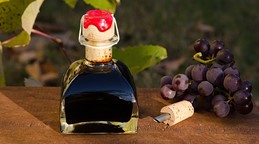 (8) (8) |
| Equivalents | ITA Aceto Balsamico di Modena ESP Vinagre Balsámico de Módena FRA Vinaigre balsamique de Modène RO Oțet balsamic de Modena |
| Note of the equivalents | In Italian, the term aceto is masculine, as well as its adjective balsamico. In Spanish the expression is masculine, as well. |
| Institution | Università degli Studi di Modena e Reggio Emilia, Dipartimento di Studi Linguistici e Culturali |
| Date | 03/04/2015 |
| Last modified | 7/05/2023 |
| Author Revisor | Lucia Palazzese Chiara Buschi Gloria Zanella |
| Sources | 1) http://www.treccani.it/vocabolario/aceto/ 2) http://www.acetaialabonissima.it/ita/aceto-balsamico-modena-igp-produzione.aspx 3) https://www.qualigeo.eu/prodotto-qualigeo/aceto-balsamico-di-modena-igp/ 4) https://www.consorziobalsamico.it/aceto-balsamico-di-modena/territorio/ 5) https://www.consorziobalsamico.it/balsamic-vinegar-of-modena/?lang=en 6) https://www.google.com/search?q=vinegar+etymology&rlz=1C1FKPE_itIT932IT932&oq=vinegar+etymology&aqs=chrome..69i57j0i19i22i30l7.2502j0j9&sourceid=chrome&ie=UTF-8 7) https://www.etymonline.com/word/balsamic 8) https://www.ilgiardinodeilibri.it/speciali/aceto-balsamico-modena-dop-igp-cosa-cambia.php |