| Headword | Parmigiano Reggiano |
| Domain and subdomain | Nutrition – dairy products (cheese) |
| Grammatical label | Noun, sing. |
| Definition | It is a PDO cheese, produced with uncooked milk, partially skimmed, and there is no use of preservatives and additives. It is cheese produced in the areas of Parma and Reggio nell’Emilia. (1) |
| Note | Parmigiano Reggiano is considered the king of cheese, characterised by a paste that changes from light straw-yellow to strong straw-yellow, with a golden crust. Thanks to the different maturations and its versatility, this cheese is the principal ingredient in a high number of recipes of the Italian tradition, it can be consummated as a table cheese, alone or combined with vegetables, salads, and fruits either fresh or in shell. It is often used grated, as condiment for first courses, soups and consommés. (2) Its structure is granular, flaky. The past has a delicate flavour with a fragrant aroma, savoury but not spicy. The cheese is exclusively produced in the areas of Parma, Reggio-Emilia, Modena and also part of the areas of Mantova and Bologna, within plains, hills and mountains between Po and Reno rivers: here we find the livestock of cows that eat fodder produced in this area. Parmigiano Reggiano is produced with skimmed milk of two daily milkings, then versed in the typical cooper cauldrons, the milk is enriched of natural rennet and graft whey: the coagulation takes place. (3) Parmigiano Reggiano origins dates to the Middle Age, approximately in the XII century. In the Middle Age, the first producers of parmigiano were Benedectine monks, that were looking for a cheese that could last. Thanks to the salt coming from Salsomaggiore salt pans and the cows grown in the grangia, they obtained Parmigiano Reggiano. The writer Giovanni Boccaccio describes in “Decameron” how people used to consummate this cheese even during that period. (4) |
| Context | Only cheeses with the Consorzio markings are the true Parmigiano. (5) |
| Phonetic transcription | [parmi‘ʤano reʤ‘ʤano ˈtʃiːz] |
| Synonyms/Variants | Parmesan (6) |
| Etymology | The name of this cheese comes from the areas of its production, between Parma and Reggio Emilia. (7) |
| Product image | 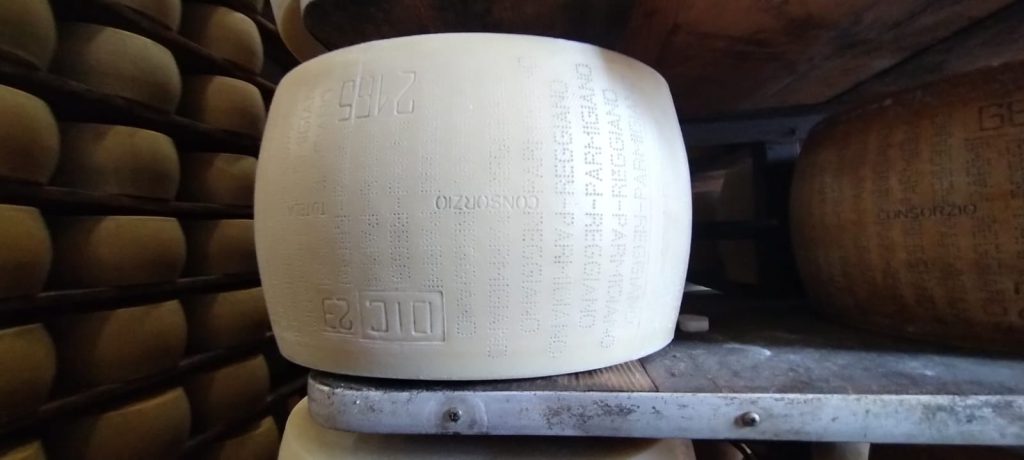 |
| Equivalents | ITA Parmigiano Reggiano ESP Queso parmigiano reggiano FRA Parmesan RO Parmezan |
| Note of the equivalents | The Italian denomination is used. Sometimes, the translation of “formaggio” is used to identify the type of product. |
| Organisation | Università degli Studi di Modena e Reggio Emilia, Dipartimento di Studi Linguistici e Culturali |
| Date of the sheet | 03/08/2021 |
| Last modified | 16/03/2024 |
| Author Revisor | Margherita Baroni Gloria Zanella |
| Sources | 1) Dizionario Italiano – Il Sabatini Coletti 2) https://www.qualigeo.eu/prodotto-qualigeo/parmigiano-reggiano-dop/ 3) https://www.qualigeo.eu/prodotto-qualigeo/parmigiano-reggiano-dop/ 4) https://www.parmigianoreggiano.com/it/prodotto-storia 5) https://www.lafromagerie.co.uk/parmigiano-reggiano 6) https://www.google.co.uk/search?q=parmesan+&source= 7) https://www.caseificio4madonne.it/blog-ed-eventi/articolo/parmigiano-reggiano-nome?utm_source=google&utm_medium=organic 8) https://www.google.com/url?sa=i&url=https%3A%2F%2Fwww.amazon.it%2FParmigiano-Reggiano-P-mesi-Caseificio%2Fdp%2FB016Y7F69C&psig=AOvVaw35-LpIUCuV9gdHvQhtla_Q&ust=1627561681767000&source=images&cd=vfe&ved=0CAsQjRxqFwoTCMCDpPHhhfICFQAAAAAdAAAAABAF |