| Headword | Chestnut from Castel Rio |
| Domain and Subdomain | Nutrition – vegetables |
| Grammatical label | Noun, sing. |
| Definition | Marrone Castel Rio makes reference to the fresh fruit obtained from the chestnut groves of the Castanea sativa M. species, by the biotypes: Marrone Domestico, Marrone Nostrano, Marrone di San Michele. (1) |
| Note | Marrone Castel Rio PGI has a ellipsoidal shape with a less pronounced tip. Being of medium-big dimensions, it has a lateral flat face, the other one is convex. The peel is thin and brown-red-coloured – with more or less dark shades – easily removable from the chamois-coloured membrane. The area of production includes the territories of Castel del Rio, Fontanelice, Casal Fiumanese and Borgo Tassignano, situated in the province of Bologna. (2) Marrone has many dietetic and nutritional substances; it presents a high level of mineral salts, like phosphor and magnesium and potassium, satisfying the need for fundamental trace elements for our well-being. Being rich in starches and complex sugars, Marrone is particularly adequate in diets of younger generations, sports people and people that do demanding physical activities. (3) The flavour and naturality of this product make it the perfect ingredient for many autumnal gourmet recipes. (4) |
| Context | Grown in the province of Bologna for centuries, Marrone di Castel del Rio is one the most valuable chestnut varieties in Italy. They are harvested in fall but can also be preserved by simple fermentation methods after which they can be enjoyed for a longer time. (5) |
| Phonetic transcription | [ˈtʃɛsnʌt ˈfrɒm ka’stɛl ‘ ri:o] |
| Synonyms/Variants | We also find the English version “Chestnut of Castel Rio”. (6) |
| Etymology | Marrone : from the medieval Latin (century XIII) marro -onis, of prelatin origin. (7) Castel del Rio is part of the municipality of Bologna (Emilia-Romagna). |
| Product image | 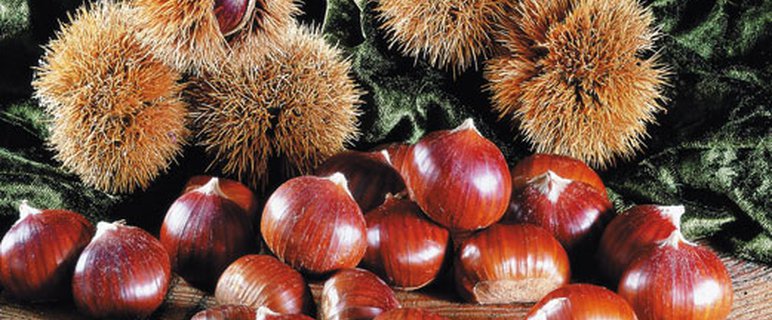 (8) (8) |
| Equivalents | ITA Marrone Castel Rio ESP Castaña Castel Río FRA Marrone Castel Rio RO Castane Castel del Rio |
| Note of the equivalents | The name of product is translated, but its place of production is kept in its Italian version. |
| Institution | Università degli Studi di Modena e Reggio Emilia, Dipartimento di Studi Linguistici e Culturali |
| Date of the sheet | 06/08/2021 |
| Last modified | 25/04/2023 |
| Author Revisor | Margherita Baroni Gloria Zanella |
| Sources | 1) https://www.qualigeo.eu/prodotto-qualigeo/marrone-di-castel-del-rio-igp/ (2) http://www.taccuinistorici.it/ita/news/medioevale/aromi-orto-frutti/Marrone-di-Castel-del-Rio-IGP.html (3) http://www.marronedicasteldelrio.it/qualita.htm http://www.enotecaemiliaromagna.it/it/i-percorsi-del-gusto/prodotti-tipici/marrone-di-castel-del-rio-igp (4) http://www.ciboitaliano.com/dettaglio_ortofrutticoli.php?id=420 (5) https://www.tasteatlas.com/marrone-di-castel-del-rio (6) https://www.google.com/search?q=chestnut+castel+rio&lr=lang_en&rlz=1C1GCEB_enIT870IT870&tbs=lr:lang_1en&sxsrf=ALeKk0154wuKfi-11mfzklQ1ZL1kJZ2yOQ:1628498557189&ei=feoQYbWLCMH0aIXAj8AE&start=10&sa=N&ved=2ahUKEwj1vY_wxaPyAhVBOhoKHQXgA0gQ8tMDegQIARA-&biw=1280&bih=609 (7) https://www.etimo.it/?term=marrone (8) http://www.enotecaemiliaromagna.it/it/i-percorsi-del-gusto/prodotti-tipici/marrone-di-castel-del-rio-igp |