| Headword | Borgotaro mushroom |
| Domain and Subdomain | Nutrition – fruit and vegetables |
| Grammatical label | Noun, sing. |
| Definition | Borgotaro Mushroom refers to fresh porcini mushrooms, dried and coming from spontaneous growth of the four varieties Boletus aestivalis, Boletus pinophilus, Boletus aereus and Boletus edulis. (1) |
| Note | Borgotaro mushrooms are characterised by an intense aroma and a mild, non-aggressive smell. There are no inflections of hay, fresh wood or liquorice, which allows the typical scent of wood and damp earth to be enjoyed to the full. These are characteristics of quality and value that set it apart from similar products from other areas. (2) It is obtained using methods that differ substantially from those typical of fruit and vegetables in that Fungo di Borgotaro PGI is not cultivated in the classic sense of the term, but is characterised by spontaneous growth. It is therefore possible to speak of ‘treatment’, referring to the management of the woods in which the harvest takes place, which differs according to environmental conditions. (3) Fungo di Borgotaro PGI can be stored for a few daysby placing it on the bottom shelf of the refrigerator or in a cool place. If you wish to keep it for a longer period, you can dry it, taking care not to wash it, but only to clean the outside surface, cut it into slices and expose it to the sun for a few days on a net. Alternatively, mushrooms can also be frozen either fresh or after cooking. Fungo di Borgotaro PGI is an ideal ingredient in the preparation of many traditional dishes. (4) The production area of Fungo di Borgotaro PGI lies in the municipalities of Albareto, Borgo Val di Taro, Bedonia, Berceto, Compiano and Tornolo in the Province of Parma, in the Emilia-Romagna Region, and in the municipalities of Pontremoli and Zeri in the Province of Massa-Carrara, in the Region of Tuscany. (5) |
| Context | The Borgotaro (Porcini) Mushroom is an extraordinary creature that comes from the intimate relationship between man and the surrounding environment. For centuries the inhabitants of these areas have maintained the woods, helping them to be the home of the Mushroom and obtaining all possible fruits.This is why Borgotaro PGI Porcini Mushroom is often described as a “spontaneous product aided by man” if, in fact, it is clear that man cannot influence atmospheric phenomena such as rain or wind, it is equally true that it can strive for careful and far-sighted forest management, thus ensuring greater forest health and fungal production. (6) |
| Phonetic transcription | [ borgo’ta:ro ˈmʌʃruːm] |
| Synonyms/Variations | We also find the English version of the product, Borgotaro mushroom. (7) |
| Etymology | Italian term “Fungo” comes from the Latin term fungus. (8) Mushroom dates back to late Middle English (originally denoting any fungus having a fleshy fruiting body): from Old French mousseron, from late Latin mussirio(n- ). (9) |
| Product image | 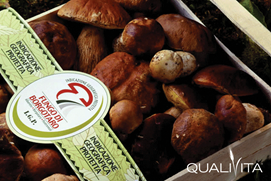 |
| Equivalents | ITA Fungo di Borgotaro ESP Seta de Borgotaro FRA Fungo di Borgotaro RO Fungo di Borgotaro |
| Note of the equivalents | The name of the product is translated, the place of production is kept in Italian. |
| Organisation | Università degli Studi di Modena e Reggio Emilia, Dipartimento di Studi Linguistici e Culturali |
| Date of the sheet | 06/08/2021 |
| Last date of change/modification | 25/04/2023 |
| Author Revisor | Margherita Baroni Gloria Zanella |
| Sources | 1) https://www.qualigeo.eu/prodotto-qualigeo/fungo-di-borgotaro-igp/ 2) http://www.agraria.org/prodottitipici/fungodiborgotaro.htm 3) https://www.google.com/culturalinstitute/exhibit/fungo-di-borgotaro/gQfOA18a?hl=it&position=9%2C99 4) https://www.qualigeo.eu/prodotto-qualigeo/fungo-di-borgotaro-igp/ 5) https://www.qualigeo.eu/en/product/fungo-di-borgotaro-pgi/ 6) https://www.travelemiliaromagna.it/en/borgotaro-porcini-mushrooms-emilia-romagna/ 7) https://www.google.co.uk/search?lr=lang_en&tbs=lr:lang_1en&q=fungo+di+borgotaro+eu+europa&sa=X&ved=2ahUKEwjIyPSGvqbyAhVKLewKHUEkDaoQ7xYoAHoECAEQMw&biw=1280&bih=609 8)https://www.treccani.it/vocabolario/ricerca/fungo/ https://www.google.com/url?sa=i&url= 9) https://www.google.com/search?q=mushroom+timology&rlz=1C1FKPE_itIT932IT932&ei=17kYYsokxu6SBYK0mPgK&ved=0ahUKEwiK7MPN3Jr2AhVGt6QKHQIaBq8Q4dUDCA4&uact=5&oq=mushroom+timology&gs_lcp=Cgdnd3Mtd2l6EAMyBAgAEA0yBggAEA0QHjIGCAAQDRAeMggIABANEAUQHjIICAAQCBANEB4yCAgAEAgQDRAeMggIABAIEA0QHjoLCAAQgAQQsQMQgwE6BQgAEIAEOgsILhCABBCxAxDUAjoICAAQgAQQsQM6CAguELEDEIMBOgsILhCxAxCDARDUAjoECAAQQzoHCC4Q1AIQQzoOCC4QgAQQsQMQxwEQ0QM6CAguEIAEELEDOgsILhCABBCxAxCDAToOCC4QgAQQsQMQxwEQrwE6BwguELEDEEM6BQguEIAEOgoIABCABBBGEP8BOgYIABAWEB46BQghEKABSgQIQRgASgQIRhgAUABY6xxg5R5oAXABeACAAXKIAe0LkgEEMTIuNZgBAKABAbABAMABAQ&sclient=gws-wiz |