| Headword | Lambrusco |
| Domain and subdomain | Beverage – wine |
| Grammatical label | Noun, sing. |
| Definition | The term Lambrusco indicates a series of red grape varieties and the wine produced from them. In Italy there are several DOC (Controlled Designation of Origin) and IGT (Protected Geographical Indication) specific for Lambrusco. (1) |
| Note | Lambrusco grapes are black, and they are mainly grown in Emilia-Romagna, in the provinces of Modena, Reggio Emilia and Parma and in Lombardy in the Province of Mantua. They are used to make sparkling wines, both red and rosé. Lambrusco is the most sold Italian red wine in Italy and exported to the world: in 2016, 400 million bottles were produced. (2) Lambrusco essentially refers to a “family of native vines”, born from plants which have grown spontaneously in the Po Valley. Nowadays, there are 12 cultivated varieties (including Sorbara, Grasparossa, Salamino, Marani, Maestri), to which other varieties not directly belonging to this family may be added, such as Ancellotta. Dry, medium or sweet, its grapes are mainly cultivated in the territories between Modena and Reggio Emilia and, in a minor quantity, in the provinces of Parma and Mantua, between Emilia and Lombardy. There are four DOC wines from Modena: Lambrusco from Sorbara, which can be cut up to 40% with the Salamino variety, Lambrusco Grasparossa from Castelvetro, Lambrusco Salamino from Santa Croce and Lambrusco from Modena. In the province of Reggio Emilia the Lambrusco Reggiano DOC originated, it is obtained from Lambrusco grape varieties such as Salamino, Sorbara, Maestri, Marani, Montericco and Grasparossa from Castelvetro, and the Lambrusco DOC Colli Scandiano and Canossa, produced from Grasparossa and Montericco grapes. In Parma, finally, Lambrusco Colli Parma DOP is produced, which must include at least 85% of the Maestri variety. Finally, there are some IGT/IGP lambruscos. (3) Lambrusco is an autochthonous wine, deeply linked to its land, constituting almost all of its cultivation. Its grapes come entirely from the territory, a source of great pride for its producers; it has a “transparent” chain; it has unique organoleptic characteristics in the world: it is sparkling and red. Nowadays, thanks to climate change, Lambrusco has acquired a structure made of aromas, flavours and complexity of all respect. The variation of the climate has greatly favoured this wine, causing its alcohol content to increase by one and a half point and reducing acidity, thus making it much more balanced and pleasant. Its cultivation, which historically has taken place on level ground, from an initial point of weakness, has become a formidable strength: in fact, on level ground wines can be produced with a lower alcohol content, and this is nowadays more appreciated by the consumer, who prefers wines that are easier to drink. (4) |
| Context | Lambrusco is the name of both an Italian red wine grape and a wine made principally from said grape. The grapes and the wine originate from four zones in Emilia-Romagna and one in Lombardy―principally around the central provinces of Modena, Parma, Reggio-Emilia, and Mantua. (5) |
| Phonetic transcription | (/læmˈbrʊskoʊ ˈwaɪn/; Italian: [lamˈbrusko]) |
| Synonyms /Variants | Over the years, the Lambrusco according has been classified to the areas of the grape variety. Lambrusco from Sorbara: takes its name from the hamlet of Sorbara in the municipality of Bomporto, in Modena. Grown in the area between the rivers Secchia and Panaro, this is an ancient indigenous variety exclusive to Modena and with very special characteristics. Another peculiarity of this vine is the phenomenon of the acinellatura, an anomaly mainly due to the sterility of pollen: the grains remain a few millimeters in diameter, causing significant product losses. This particular characteristic makes this particular red wine unique and precious. Lambrusco from Sorbara is produced in different types: semi-sparkling and sparkling red, semi-sparkling and sparkling rosè. Lambrusco Grasparossa: also known as Lambrusco Castelvetro or Lambrusco Spezzano, it is a sparkling and dry wine, with an intense ruby red colour with violet reflections and a fruity scent, with hints of berries. A particular characteristic of this grape is that in autumn not only are the leaves red, but also the stalks and pedicels are, creating a particularly suggestive colouration that enriches its areas with charm during the harvest. Lambrusco Salamino: this variety of vine originates in the soils of the lower Modena and, like the others, probably comes from wild vines that grew spontaneously on the hills of the Apennines. For this reason, these grapes were also called “uzeline” or “oseline” due to the fact that, growing spontaneously at the edge of the woods, they were plundered by the birds that were greedy of them. The Lambrusco Salamino Santa Croce DOC owes its name to the homonymous hamlet of the Municipality of Carpi, from which this vine has then spread throughout the territory of the province of Modena and in those bordering. It is a lively and fresh wine, ruby red in colour and with a fruity and intense aroma. The bunches are small, with blue-blackish berries and slightly acidulous juicy flesh. Lambrusco Modena: it joined the category of Lambrusco DOP wines only in 2009, Lambrusco Modena is produced using a mixture of different types of grapes (technically “uvaggio” [= blend])). The 85% is made up of different types of Lambrusco grown in the province of Modena, while for a maximum of 15% it is possible to use grapes from the Ancellotta, Malbo Gentile and Fortana varieties. It shows a ruby red colour with violet nuances in the foam, very pleasant aroma and marked floral and fruity notes. It is perfect in combination with first courses of meat and Emilian cold cuts. (6) Lambrusco Bianco from Emilia: a young and fresh wine, medium-bodied, characterized by a distinct roundness, balanced by an excellent acidity. It leaves a pleasant aftertaste of berries and gooseberries in the mouth. It is produced in the grapes of Emilia Region. The ripening is usually achieved between late September and early October, depending on the different varieties of Lambrusco grapes. (7) |
| Etymology | The most common hypothesis about the origin of the name Lambrusco concerns the derivation from the Latin terms labrum (edge, margin) and ruscum (spontaneous plant): the Romans adopted the term labrusca to indicate the spontaneous growth of this vine in the perimeters of the fields. The first wines of the history were in fact produced with wild grapes, what today we call “non-domesticated” vines. (8) |
| Product image | 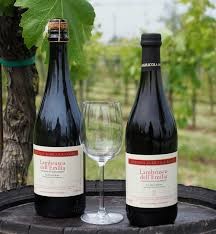 (9) (9) |
| Equivalents | ITA Lambrusco ESP Lambrusco FRA Lambrusco RO Lambrusco |
| Note of the equivalent | In Italian it is unnecessary to specify that it is a type of wine. In English, the Italian name is retained and it is followed by a short and effective description. |
| Institution | Università degli Studi di Modena e Reggio Emilia, Dipartimento di Studi Linguistici e Culturali |
| Date | 9/10/2021 |
| Last modified | 25/04/2023 |
| Author Revisor | Chiara Buschi Gloria Zanella |
| Sources | 1)https://it.wikipedia.org/wiki/Lambrusco 2)https://it.wikipedia.org/wiki/Lambrusco 3)https://www.vinicum.com/it/racconti/lambrusco-frizzante-vivace-e-conviviale/ 4)https://www.vinicum.com/it/racconti/lambrusco-frizzante-vivace-e-conviviale/ 5)https://en.wikipedia.org/wiki/Lambrusco 6)https://shop.silvanoromaniparma.it/tipologie-lambrusco 7)https://www.contrispumanti.com/it/vini/vino-frizzante-lambrusco-igt-dellemilia-bianco-amabile-507 8)https://www.la-salumeria.it/gastronomia-online/vini/lambrusco-cantina-puianello 9)https://www.google.com/search?q=lambrusco+bianco+dell%27emilia+info&rlz=1C1FKPE_itIT932IT932&sxsrf=AOaemvIEVALtwcgMet79MPegUUomdIXZ3w:1633781601325&source=lnms&tbm=isch&sa=X&ved=2ahUKEwiv0_Lfpr3zAhUKzaQKHbbgAVwQ_AUoAnoECAEQBA&biw=928&bih=585&dpr=1.56#imgrc=Cyij2fLEo8j4_M 10)https://it.pons.com/traduzione/inglese-italiano/Lambrusco |