| Headword | Coppa from Parma |
| Domain and Subdomain | Food – meat |
| Grammatical label | Noun, sing. |
| Definition | Cured meat consisting in the whole piece of muscular section of the pig neck, trimmed in order to model a cylindric shape. (1) |
| Note | Coppa Parma PGI is obtained from Italian pig meat manufactured and aromatised with coarse salt, pepper, spices, before its bagging into natural bovine or pig intestines and before being tied off with twine hemp. (2) After the salting and drying phases, the product needs to age (3): the aging lasts for a minimum period of 60 days in which the meat acquires parfum, aroma and fragrance and a delicate and savoury flavour, while the twines slowly come undone. (4) Coppa Parma PGI is a cylindric cured meat, with a non-flattened shape. On the exterior it must not present greasiness or oily sheens and the intestines must easily come off. When cut, the slice must have a tender consistence, with white/rose fat parts and dark red lean parts. It has a delicate, aromatic, not too salty but almost sweet flavour. Traditional methods indicated that in order to preserve Coppa Parma for a longer period of time, it was good to wrap it into a dry cotton cloth soaked in white wine (usually “Colli di Parma Malvasia” that does not alter the smell of Coppa). (5) Coppa Parma PGI can have a leading role in cutting boards for starters and aperitifs. It is interesting the combination with green vegetables like rocket or spinach. (6) |
| Context | Coppa di Parma obtained PGI recognition (Protected Geographical Indication) in 2011. (7) |
| Phonetic transcription | [‘kɔppa frəm ‘parma] |
| Synonyms/Variants | ND |
| Etymology | Coppa: it comes from the late Latin term cŭppa(m) with the meaning of “barrel” and then used in order to indicate a round shape. (8) Parma is a town of the Italian region Emilia-Romagna. |
| Product image | 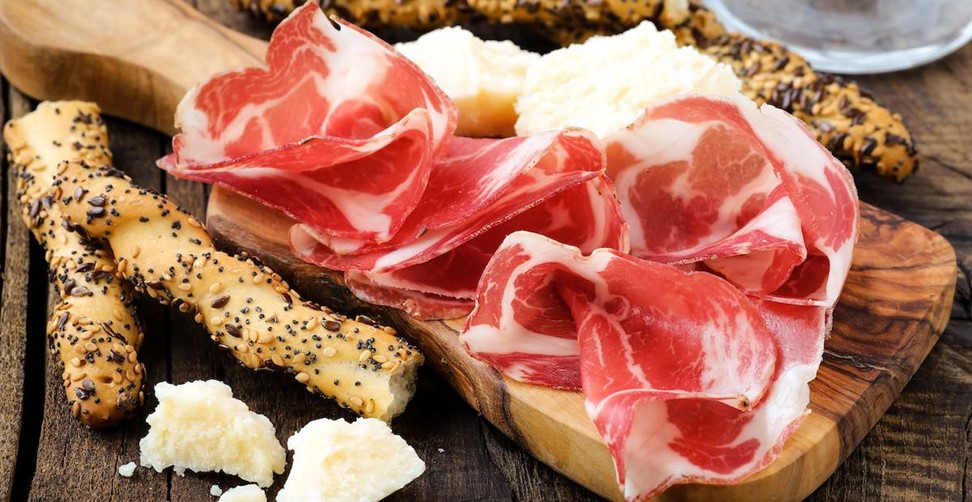 (9) (9) |
| Equivalents | ITA Coppa di Parma ESP Coppa de Parma FRA Coppa di Parma RO Coppa di Parma |
| Note of the equivalents | The term “coppa” is always used. |
| Institution | Università degli Studi di Modena e Reggio Emilia, Dipartimento di studi linguistici e culturali |
| Date | 06/08/2021 |
| Last modified | 25/04/2023 |
| Author Revisor | Margherita Baroni Gloria Zanella |
| Sources | 1)http://www.cibo360.it/qualita/certificazioni/salumi/coppa_parma.htm (2) http://www.coppadiparmaigp.com/coppa-di-parma-igp/come-si-produce/ (3) http://www.coppadiparmaigp.com/coppa-di-parma-igp/come-si-produce/ (4) http://www.coppadiparmaigp.com/coppa-di-parma-igp/come-si-produce/ (5) http://www.cibo360.it/qualita/certificazioni/salumi/coppa_parma.htm (6) https://www.spaghettiemandolino.it/blog/134-coppa-stagionata-parma-igp-bio.html (7) https://www.salumificiopedrazzoli.it/portfolio_page/coppa-parma-bio-pgi/?lang=en&cn-reloaded=1 (8) http://www.garzantilinguistica.it/ricerca/?q=coppa%201 (9) http://www.agraria.org/prodottitipici/coppa-di-parma.htm |