| Headword | Grana Padano |
| Domain and Subdomain | Nutrition – cheese |
| Grammatical label | Noun, sing. |
| Definition | It is a hard paste cheese, cooked and slowly aged, produced by coagulation, made from cow milk, whose nutrition is composed of green and preserved fodder. (1) |
| Note | Grana Padano PDO has a cylindric shape; the crust is hard, smooth and big, straw or brown-coloured. The paste is hard, granular, straw or white-coloured, with fine hole, sometimes less visible, regularly distributed. (2) The aging of Grana Padano goes from 9 months for the “fresh” variety to more than 20 months for the “old” varieties. The years give the paste a different flavour: delicate in the youngest cheese, gradually more savoury for the most aged. (3) Because of its hard consistence, Grana Padano should not be cut, but “broken” by using the so-called knife “a goccia”, teardrop. Nutritional properties of Grana Padano are good. It represents a good source of calcium, phosphor and proteins with high organic value; at the same time, it has a high number of calories, sodium chloride and glutamate. (4) Table cheese or grated, it is perfect on “pastasciutta” and on stuffed pasta, in which it is also part of the filling. If not aged more than 12 months, it is perfect to be comined with white strong wines. If it is old, it is great with red wines. (5) |
| Context | Grana Padano is what it is today because of its heritage. The characteristic branding, the unique taste and the techniques preserved and continued for centuries all symbolise the rich history from which Grana Padano was derived. The history and culture behind the creation of Grana Padano are a perfect example of how history shapes the future. The beautiful landscape and history of the Grana Padano production area tell a unique story which carry on for many years to come. (6) |
| Phonetic transcription | [‘grana pa’dano] |
| Synonyms/Variants | ND |
| Etymology | The term « Grana » comes from the Latin term grana, plural of granum, “grain of wheat”. The origin of Grana Padano dates of XI century: in the Padana valley they produced several cheese characterised by a granular structure. In 1954, a law recognised the denomination “Grana Padano”, unifying the several productions of the zone. (7) Be careful in using the term “Grana” without the adjective “Padano”: the law affirms that these two words must be always together in order to indicate the unique Grana Padano. (8) |
| Product image | 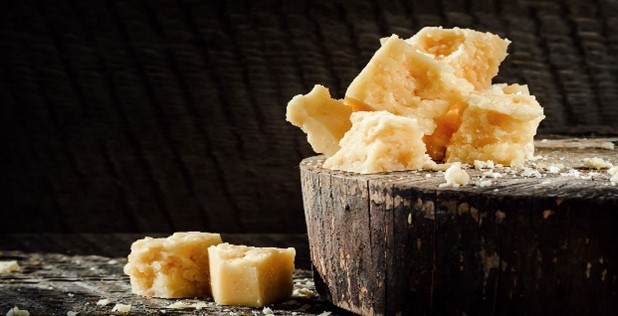 (9) (9) |
| Equivalents | ITA Grana Padano ESP Grana Padano FRA Grana Padano RO Grana Padano |
| Note of the equivalents | Italian version is used. |
| Institution | Università degli Studi di Modena e Reggio Emilia, Dipartimento di studi linguistici e culturali |
| Date | 06/08/2021 |
| Last modifed | 25/04/2023 |
| Author Revisor | Chiara Buschi Gloria Zanella |
| Sources | 1) https://www.qualigeo.eu/prodotto-qualigeo/grana-padano-dop/ 2) http://www.formaggio.it/formaggio/grana-padano-d-o-p/ 3) https://www.granapadano.it/it-it/le-stagionature-1.aspx 4) http://www.my-personaltrainer.it/alimentazione/grana-padano.html 5) http://www.formaggio.it/formaggio/grana-padano-d-o-p/ 6) https://www.granapadano.it/en-ww/production-process-1.aspx 7)https://www.treccani.it/vocabolario/ricerca/grana/#:~:text=grana%20%5BDer.,cui%20%C3%A8%20suddiviso%20un%20materiale 8) https://www.granapadano.it/it-it/la-storia.aspx 9) https://www.regione.lombardia.it/wps/portal/istituzionale/HP/DettaglioRedazionale/scopri-la-lombardia/gustare-i-sapori-lombardi/formaggi-lombardi-google-arts-culture |