| Headword | Pork cracklings |
| Domain and subdomain | Food – meat products |
| Grammatical label | Noun, pl. (collective) |
| Definition | Roasted pork fat residue, fused in order to produce lard. (1) |
| Note | Pork crackling is a typical Emilian appetizer made from pork fat. (2) Pork crackling is the dense residue of lard production. The pork fat that is not used in the production of cured meats is skinned and diced, put to cook in a large pot and melted over a low heat, with salt added. It cooks for at least three hours, until the water evaporates, and the meat has turned brown. When pork crackling is cooked, it is poured into a cloth, squeezed to remove all the lard and flavoured with cinnamon, pepper, bay leaf, nutmeg. All the melted fat constitutes the lard, it is filtered and put in containers. The cracklings are a high-calorie food that represented an excellent meal in the peasant tradition, often combined with polenta. Nowadays, they mainly combine with appetizers. When crumbled, they make focaccia, bread and polenta much tastier. The cracklings vary in shape and size according to the shape of the residues. They can be stored for up to three or four months. They have amber golden colour, sweet taste, oily and greasy sensations and soft texture. The matching requires a wine whose characteristics are freshness, youth, even crispness and of course acidity. (3) After a long cooking, the traditional cracklings are pressed so that they take on their characteristic shape, giving life to the classic square slice of Cicciolo. The Campagnoli cracklings are characterized by an artisan component in the pressing, because it takes place inside canvases, giving the product a low and rounded shape. The Campagnoli cracklings are also best cared for in the dough, using cuts of bacon, throat and selected spices. They can be eaten as cold cuts accompanied by typical products of the Emilia-Romagna cuisine such as Tigelle and Piadina. (4) |
| Context | The farming village is well-known for the delicious Ciccioli (Pork Cracklings); it is also famous for the Vinegar Cellars, the Lambrusco Reggiano Wineries and the cheese factories that produce Parmigiano-Reggiano cheese. (5) |
| Phonetic transcription | [ˈpɔːrk ˈkræklɪŋs] |
| Synonyms/variants | Siccioli, grassoli, lardinzi, grépòle, cicoli, o sfrizzoli. |
| Etymology | The general consensus of opinion is that they originated in the West Midlands or Black Country as it is sometimes called because of the area’s roots in the industrial revolution. Pork Scratching/crackling was a food typical of the working classes with origins back to the 1800’s, when families kept their own pigs at home, feeding them up for slaughter. As food availability was scarce, no part of the pig was wasted and either by design or trial & error the famous Pork Scratchings/Cracklings were discovered. (6) |
| Product image | 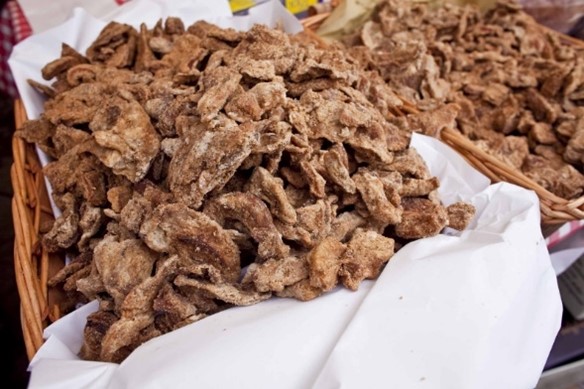 (7) (7) |
| Equivalents | ITA Ciccioli ESP Chicharrones FRA Cretons RO Jumări |
| Note of the equivalents | The plural form is always used. |
| Institution | Università Degli Studi di Modena e Reggio Emilia, Dipartimento di Studi Linguistici e Culturali |
| Date | 17/08/2021 |
| Last modified | 25/04/2023 |
| Author Revisor | Chiara Buschi Gloria Zanella |
| Sources | 1) https://www.google.com/search?q=ciccioli+definizione&rlz=1C1FKPE_itIT932IT932&oq=ciccioli+definizione+&aqs=chrome..69i57j0i22i30.4176j0j4&sourceid=chrome&ie=UTF-8 2) https://www.gustissimo.it/ricette/antipasti-carne/ciccioli-ricetta.htm 3) http://norcinibergamaschi.it/modules_cms/ContPage.php?cp=M070d000000 4) https://gigisalumificio.it/i-ciccioli-morbidi/ 5) https://emiliaromagnaturismo.it/en/towns/campagnola-emilia 5) https://www.sniks.co.nz/page/history-of-pork-crackle/ 6) https://static.lexicool.com/dictionary/GZ2XS26441.pdf |